 PickGuide
LiTime 12V 320Ah ComFlex Review: CAN Bus LiFePO4 at $883.49
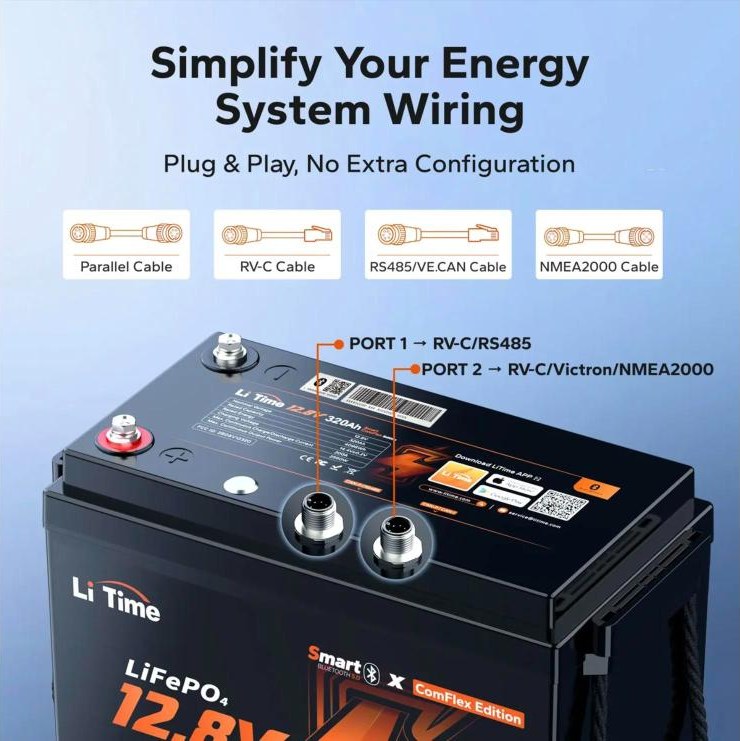
Most drop-in lithium batteries are a sealed box that tells you nothing. The LiTime 12V 320Ah ComFlex is built around the opposite idea: CAN and RS485 ports that speak Victron, RV-C and NMEA 2000, so the battery reports its real state to the rest of your system instead of leaving the charge controller guessing. It adds dual-mode self-heating for freezing conditions, packs 320Ah into a case LiTime says is 35 percent smaller than a typical 12V 300Ah LFP battery, and expands to 16 units in parallel. At $883.49 against a $1,299.99 list it is LiTime's current best seller, with a 5-year warranty and free shipping from US warehouses.
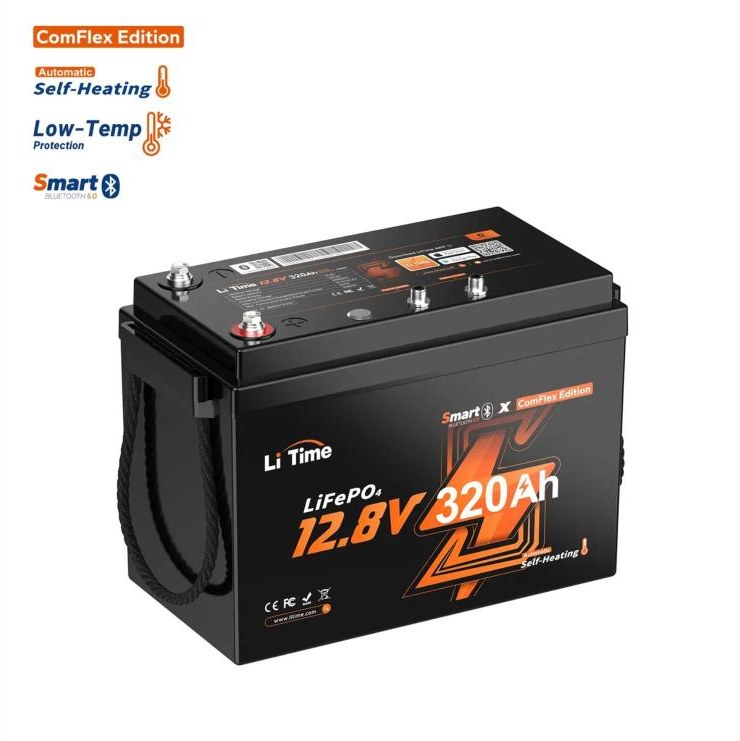
LiTime 12V 320Ah CAN & RS485 ComFlex Smart LiFePO4 Battery. Capacity: 320Ah at 12.8V, roughly 4096Wh. Communication: dual CAN and RS485 ports, compatible with Victron, RV-C and NMEA 2000 protocols for real-time battery status synchronisation. Cold weather: low-temperature protection with dual-mode self-heating. Dimensions: 14.49 x 7.44 x 10.04 in, which LiTime states is 35 percent smaller than typical 12V 300Ah LFP batteries. Expansion: up to 16 batteries operating together (16P1S parallel communication; 4P4S standard installations). App control included. Warranty: 5 years. Price: $883.49 for a single battery against a $1,299.99 list; $1,713.97 for two; $3,392.60 for four; $1,054.48 bundled with a 12V 60A charger; $1,504.46 as the Mini ComFlex off-grid kit. Store terms: free fast shipping from US local warehouses, second-day delivery available, 30-day price guarantee.
Pros
- CAN and RS485 with Victron, RV-C and NMEA 2000 support - the battery reports real state of charge instead of leaving your system to estimate it
- Dual-mode self-heating with low-temperature protection, which is what stops LiFePO4 being damaged by charging below freezing
- 35 percent smaller than a typical 12V 300Ah LFP pack, so it fits bays that will not take a conventional battery of this capacity
- Expands to 16 batteries in parallel, meaning the first purchase does not cap the system you can eventually build
- 5-year warranty and a 30-day price guarantee, with free shipping from US warehouses rather than from overseas
- At $883.49 the cost per watt-hour undercuts an equivalent all-in-one power station substantially
Cons
- This is a bare battery - an inverter, charger, wiring and fusing are all separate purchases
- Installation assumes real DC electrical knowledge; getting it wrong with 320Ah of lithium is dangerous, not just inconvenient
- The communication features only pay off if you already run a compatible system such as Victron - on a basic setup they go unused
- 320Ah in one case is heavy and awkward to position in a confined battery bay, even at reduced dimensions
- The discount is against a $1,299.99 list price that is unlikely to be the real market price, so judge it on the $883.49 figure alone
Who It's For
Good For
- RV and van builds where battery bay space is genuinely tight and capacity still has to be high
- Marine installations that benefit from NMEA 2000 integration with existing instruments
- Anyone already running Victron equipment who wants the battery and charge controller to agree on state of charge
- Cold-climate users where an unheated battery would otherwise refuse to charge for months of the year
- Off-grid builders planning to scale up, given the 16-battery expansion path
Skip If
- You want backup power you can use the day it arrives - an all-in-one power station needs no wiring at all
- You have no DC electrical experience and no electrician lined up
- Your system has no CAN or RS485 capability, in which case a cheaper battery without the communication hardware does the same storage job
How It Compares: LiTime 12V 320Ah ComFlex LiFePO4 Battery vs Jackery HomePower 3000
| Spec | LiTime 12V 320Ah ComFlex LiFePO4 Battery | Jackery HomePower 3000 |
|---|---|---|
| Price | $883.49 | $1,499.00 |
| Format | Bare battery | All-in-one with inverter |
| Energy | About 4096Wh | 3072Wh |
| Setup | Wiring and components required | Unbox and plug in |
| Cold weather | Self-heating | Not specified |
| Best setting | RV, marine, off-grid build | House backup |
| Warranty | 5 years | 5 years |
More energy for less money, in exchange for having to build the system around it. The ComFlex is the right choice when you are wiring a vehicle or an off-grid setup and want the battery to integrate with equipment you already own. The Jackery is the right choice when you want to carry a box to the kitchen during a blackout and plug the fridge into it. Neither is better value in the abstract - it depends entirely on whether you want a component or an appliance.
Verified Ratings
Key Specs
| Capacity | 320Ah at 12.8V (about 4096Wh) |
| Chemistry | LiFePO4 |
| Communication | CAN + RS485 (Victron, RV-C, NMEA 2000) |
| Cold weather | Dual-mode self-heating, low-temp protection |
| Dimensions | 14.49 x 7.44 x 10.04 in |
| Expansion | Up to 16 batteries (16P1S / 4P4S) |
| App control | Yes |
| Warranty | 5 years |
| List price | $1,299.99 (currently $883.49) |
In The Box
- 1 x LiTime 12V 320Ah ComFlex LiFePO4 battery
- Terminal bolts and user manual
- (Charger included only with the charger bundle; inverter and wiring are not included)
Frequently Asked Questions
What do the CAN and RS485 ports actually change day to day?
They let the battery's management system talk to your charge controller, inverter and display instead of each component working from voltage alone. That matters specifically with LiFePO4 because its voltage stays nearly flat from around 90 percent down to 20 percent state of charge, so a voltage-based gauge is close to useless in the middle of the range. With CAN or RS485 connected to a Victron, RV-C or NMEA 2000 system, your display shows the battery's own reported state of charge, and the charger can respond to real cell data. On a system with no compatible equipment these ports simply sit unused.
Why does self-heating matter on a lithium battery?
LiFePO4 cells can be discharged in the cold, but charging them below freezing causes lithium plating, which permanently damages capacity. For that reason most lithium batteries simply refuse to accept charge below 0C, which in a cold climate can mean the battery is effectively unusable for months. Dual-mode self-heating draws a small amount of power to warm the cells to a safe charging temperature first. If you are installing in a heated space or a warm climate, this feature adds cost you will not use; in a van or boat that overwinters outdoors, it is the difference between a working system and a dead one.
How much usable energy is 320Ah really?
At a nominal 12.8V, 320Ah works out to roughly 4096 watt-hours. Unlike lead-acid, LiFePO4 can be discharged deeply without damage, so most of that is genuinely usable rather than the roughly half you would get from a comparable lead-acid bank. For context, that is enough to run a 12V compressor fridge for several days, or to cover a typical van-life electrical load including lighting, water pump, laptop charging and a diesel heater's electrical draw for a couple of days without input.
What else do I need to buy to make this work?
At minimum an inverter if you want AC outlets, a suitable lithium-profile charger or DC-DC charger, appropriately sized cable, a main fuse or breaker, and a battery monitor if your system does not already have one. LiTime sells the battery bundled with a 12V 60A charger at $1,054.48, and a Mini ComFlex off-grid kit at $1,504.46, which cuts down the component sourcing. Budget realistically: the surrounding equipment on a first build frequently costs as much as the battery itself.
What are the shipping and warranty terms?
LiTime ships free and fast from local US warehouses, with second-day delivery available, which avoids the long international transit common on lithium batteries. The ComFlex carries a 5-year warranty, and LiTime advertises a 30-day price guarantee, so a price drop shortly after purchase can be claimed back. As with any lithium battery, shipping restrictions can apply on some routes and destinations - worth confirming at checkout if you are outside the continental US.
Verdict
The ComFlex earns its price on one feature more than any other: it tells the rest of the system the truth. Most drop-in lithium batteries leave a charge controller to infer state of charge from voltage, which is unreliable on LiFePO4 because the voltage curve is almost flat through the usable range. CAN and RS485 with Victron, RV-C and NMEA 2000 support removes that guesswork, and on a well-equipped RV or boat that is worth real money in avoided deep discharges. The self-heating matters just as much in cold climates, where a standard LiFePO4 pack simply refuses to charge below freezing. What you are not buying is convenience - this is raw storage, and the inverter, charging and fusing around it are your problem. If you already own that equipment and know how to wire it, $883.49 for 320Ah with a 5-year warranty is strong value. If you do not, buy a finished power station instead and accept the higher cost per watt-hour.